
Trajectory Enterprise - Founders Story
Trajectory Enterprise - Founders Story
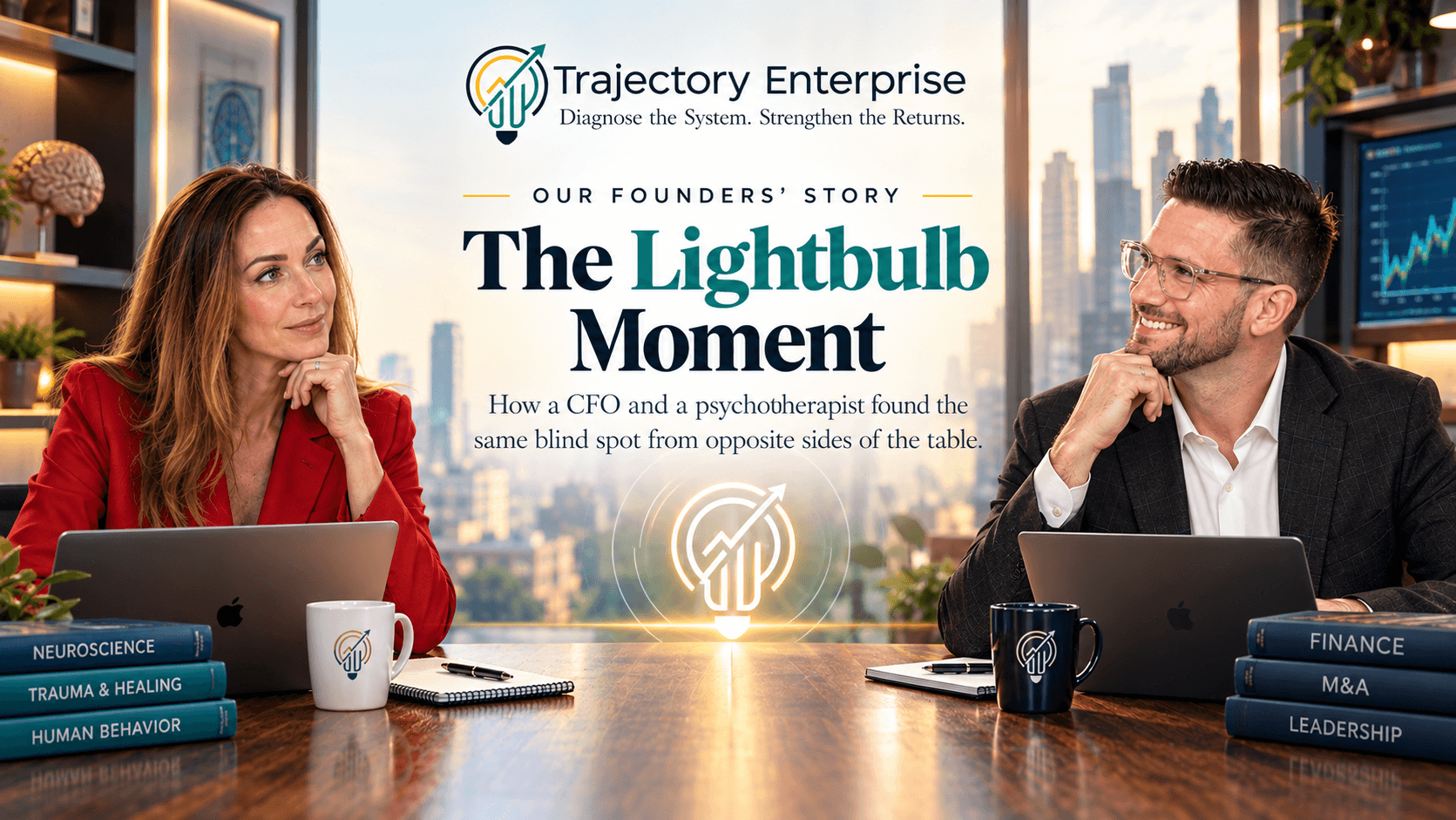
How a CFO and a psychotherapist found the same blind spot from opposite sides of the table
It started at two different tables, years before either of them knew they were building the same thing.
Matt's Table
Matt Wilhelmi spent his early career as a CFO and M&A advisor, much of it inside family-run businesses. Those are some of the most demanding rooms in business, and he noticed something early. The people closest to the problems were almost always the least able to name them.
It was not for lack of capability. No one had ever shown them what to look at, how to look at it, or how to fix the structural issue underneath once they found it. So the strain went unnamed, and it got pinned on a person instead. This leader wasn't cutting it. That hire was the wrong fit. The same conversations happened with the same people until someone quit, and then the cycle reset with the next person in the seat.
By 2017, Matt had built his first organizational diagnostic tool to get underneath that pattern. It proved his instinct was right, but it leaned entirely on his own expertise to read the signals. It could describe a problem only as well as the people in the room could explain it to him. It could not measure the problem, and it could not show whether anything had actually changed.
That limitation sent him back to school. His graduate work in Industrial-Organizational Psychology gave him the language for what he had been watching for years, and the research training to build something that did not depend on him being in the room. It also showed him a blind spot in the field. Nearly all of the research on burnout pointed at the individual: how tired this person was, who needed time off. Burnout doesn't only happen to people. It happens to organizations. And almost no one was measuring it there.
Over the following years, Matt gathered qualitative data from more than 500 organizations through post-acquisition integration work, refining what would become the Trajectory Intelligence Assessment. What started as a way to speed up post-deal integrations became a bigger conviction: good diagnosis could be taught to others, not just performed by the one person who happened to be good at it.
The Name That Didn't Belong to Him
Graduate school also gave Matt his first real scare. In a course on the biological bases of behavior, he found research showing how chronic strain breaks down into four distinct failure points. Thinking narrows and stiffens. Reactions sharpen and misfire. People pull back from those around them. And they lose the ability to learn from what just happened.
He was thrilled. He finally had a name for what he had watched happen to executives for years, and he had even given the four a name of his own: the Four Horsemen. He brought it home to Amy the way you bring home anything you're proud of.
Amy's response was not what he expected. "You can't call them the Four Horsemen," she said. "That's Gottman's term. Everyone in my field will hear that and think marriage research, not organizations."
She was right about the name, and he was right about the mechanism. It was the first sign that this could not stay a one-person project. Matt needed someone who knew the clinical and neurobiological terrain well enough to tell him when he was borrowing language that wasn't his, and who could help him build a vocabulary of its own.
Amy's Table
Amy's table looked nothing like a boardroom, but the pattern was identical.
As a psychotherapist, Dr. Amy Wilhelmi built her practice around tools most therapists never touch: qEEG brain mapping, neurofeedback, which she trained in with Drs. Michael and Lynda Thompson at the ADD Centre and Biofeedback Institute of Toronto, and EMDR. That combination pulled her deep into neuroscience. It gave her something most clinical training does not: a way to actually see what was happening underneath a person's stuck patterns, instead of only hearing them described secondhand.
What she saw, over and over, was this. People who are stuck cannot diagnose their own root cause. Even when someone hands them the diagnosis, they are rarely able to fix it without real, structured help. Insight alone doesn't move anyone. The nervous system has to be retrained, deliberately, with someone who knows how.
Amy went on to become an AAMFT Approved Supervisor, training other therapists in exactly this work, and to teach graduate students as faculty at Northwestern, DePaul, and Naropa. Her career became the study of how change actually happens, and how rarely it happens by accident.
Then They Sat Down at the Same Table
Matt walked Amy through the assessment, excited about what it could surface. Amy listened, and then asked the question that punctured the excitement: what makes this any different from an engagement survey?
Matt didn't have an answer. Amy did.
"If we just give them a report, it's going to live in a drawer like every other assessment."
"So then what?" Matt asked.
"If we hand them the report, it's like giving them a fish. They eat for a day, and nothing changes. If we teach them how to read it, and how to act on what it's telling them, we've taught them to fish. They eat for a lifetime."
That one conversation turned into months of them. They sat together with the statistics and the early findings, and the more they dug in, the bigger the idea got. It was Amy who named what they were really building. Not a survey. Not a one-time report. An organizational version of the DSM: a shared, structured way of naming what is actually wrong inside a company, so the diagnosis means the same thing to everyone who reads it, and the path to treatment follows from the diagnosis instead of being guessed at. Today, that is the Organizational Diagnostic Manual.
It was the same insight Amy had spent her career proving in the therapy room, now aimed at an organization instead of an individual. And it matched exactly what Matt had watched from the other side: leaders who were stuck, who couldn't see the structural cause of their own strain, and who got worse, not better, when all they were offered was a diagnosis and a door.
Why Trajectory Exists
That conversation is the reason Trajectory exists in its current form. Not an assessment that gets read once and filed away, but a living, research-backed system that can be taught, put into practice, and run again, so you can watch the needle move. The goal is an organization that can carry more pressure without it turning into strain. We call this Organizational Maturity.
One founder came to it through deals, finance, and the mechanics of value creation. The other came through brain maps, trauma protocols, and years of teaching clinicians how change actually sticks. Each of them, on their own, had found the same blind spot: the people inside a stuck system are usually the last to see what is wrong with it, and almost never able to fix it alone.
That is why Trajectory Enterprise exists.
Diagnose the system. Strengthen the returns.
About the Founders
Matt Wilhelmi, Co-Founder and CEO. A former CFO and M&A advisor with graduate training in Industrial-Organizational Psychology, Matt built the Trajectory Intelligence Assessment from years of post-acquisition integration work.
Dr. Amy Wilhelmi, LMFT, CST, Co-Founder and Chief Transformation Officer. A psychotherapist, AAMFT Approved Supervisor, and graduate faculty member, Amy leads Trajectory's methodology, coaching, and the work of making change last.