Every strategy eventually meets the same test: can the organization actually execute it. Boards approve the plan, operating partners set the targets, and coaches get brought in to sharpen the leaders responsible for delivering it. Yet the same pattern shows up across industries and hold periods. The strategy was sound. The people were talented. The results still fell short.
The variable most diligence processes and most coaching engagements skip over is Organizational Maturity: the organization’s underlying capacity to absorb pressure and still execute. Not sentiment. Not stated readiness. Capacity. And it can be diagnosed with the same rigor applied to a financial model.
Why “Maturity” Is the Right Lens
Most conversations about organizational performance default to one of two vocabularies. The first is financial: EBITDA, revenue growth, margin. The second is emotional: engagement, morale, culture. Both are useful, and both miss the layer in between.
That middle layer is what determines whether a strategy survives contact with reality. An organization can have strong financials and high engagement scores and still lack the capacity to execute a demanding growth plan, because engagement measures how people feel about their work, not whether the system around them can support the load being placed on it.
This is also why “Organizational Health” is the wrong term for what actually needs measuring. Health implies a single state, sick or well. What leaders need to know is narrower and more useful: whether the organization has the capacity, under its current demands, to execute what is being asked of it. That is Organizational Maturity, and it behaves less like a diagnosis and more like a load rating.
The Three-Layer View
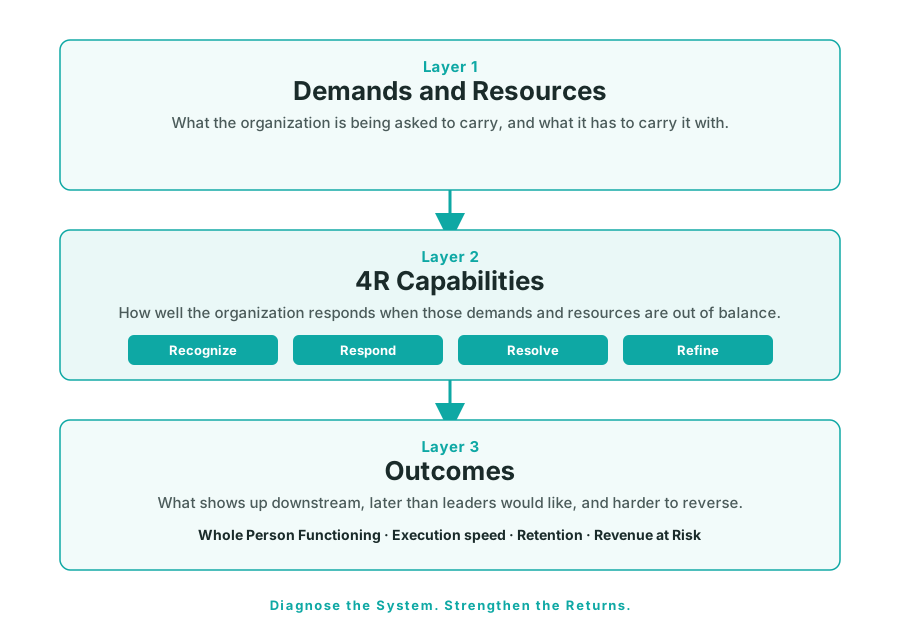
Layer 1: Demands and Resources. This is the foundation, built on the Job Demands-Resources model developed by Demerouti, Bakker, Nachreiner, and Schaufeli (2001) and refined over two decades of subsequent research (Bakker & Demerouti, 2007; Bakker, Demerouti, & Sanz-Vergel, 2023). The model’s core claim is simple and well supported: every job and every organization can be described by the demands placed on it and the resources available to meet those demands. When demands consistently outpace resources, strain accumulates. When resources are sufficient, even high-demand environments can sustain strong performance. This is the layer that explains why two portfolio companies with similar growth targets can have completely different outcomes depending on what resources their leadership teams actually have to work with.
Layer 2: Capability. Demands and resources describe the conditions an organization operates under. They do not by themselves explain how well an organization responds to those conditions. That is the role of organizational capability, the set of behaviors that determine whether a system under load adapts or breaks. Trajectory’s own research frames this capability across four dimensions, referred to as the 4R Framework. The full mechanics of how those four dimensions are measured and scored are proprietary, but the underlying premise draws on established findings that acute and chronic stress measurably degrade cognitive flexibility and decision quality (Kalia et al., 2018), and that social support functions as a buffer against those effects (Cohen & Wills, 1985). An organization’s capability layer is, in effect, a measure of how well it protects its people’s capacity to think clearly and act well when demands are high.
Layer 3: Outcomes. This is where strategy either survives or doesn’t. When demands and resources are imbalanced and capability is thin, the result shows up as constrained Whole Person Functioning, slower execution, and revenue that fails to materialize on the timeline the plan assumed. When resources and capability are sufficient, the same demands can be absorbed without the same cost. Outcomes are the layer most measurement systems focus on, financial results, engagement scores, retention, but by the time a problem is visible there, it has usually been building for months in the layers underneath it.
What a Rigorous Diagnostic Changes
The value of measuring all three layers, rather than just the outcomes layer, is timing. A financial report tells a leader what already happened. An engagement survey tells a leader how people currently feel. Neither one reliably tells a leader whether the organization can absorb what is coming next.
A diagnostic built on demands, resources, and capability produces something different: an Intervention Plan that identifies where the organization is under strain, how severe that strain is, and how remediable it is given the resources already available. That is a fundamentally different kind of output than a single composite score. A single number tells a leader whether things are good or bad. A capability-and-severity view tells a leader where to act first, and what kind of action will actually work there.
This distinction matters most in two settings. The first is private equity, where the gap between diligence and delivery is often a human capital gap that never got measured before the deal closed. The second is executive coaching, where an individual leader’s growth can be undone by an organizational environment that was never addressed alongside them. In both cases, the missing piece is the same: a way to see organizational capacity as clearly as financial performance is already seen.
Where This Goes Next
Organizational Maturity is not a soft concept. It is measurable, it changes over time, and it predicts execution risk before that risk shows up in a P&L. The rest of this series works through what that looks like in practice: what happens to leadership teams after a deal closes, why change readiness surveys miss the variable that actually matters, what a national dataset of working adults reveals about strain patterns, and why coaching a single leader without addressing the system around them rarely produces lasting change.
Diagnose the system. Strengthen the returns.
References
Bakker, A. B., & Demerouti, E. (2007). The Job Demands-Resources model: State of the art. Journal of Managerial Psychology, 22(3), 309-328.
Bakker, A. B., Demerouti, E., & Sanz-Vergel, A. (2023). Job Demands-Resources Theory: Ten years later. Annual Review of Organizational Psychology and Organizational Behavior, 10, 25-53.
Cohen, S., & Wills, T. A. (1985). Stress, social support, and the buffering hypothesis. Psychological Bulletin, 98(2), 310-357.
Demerouti, E., Bakker, A. B., Nachreiner, F., & Schaufeli, W. B. (2001). The job demands-resources model of burnout. Journal of Applied Psychology, 86(3), 499-512.
Kalia, V., Vishwanath, K., Knauft, K., Von Der Vellen, B., Luebbe, A., & Williams, A. (2018). Acute stress attenuates cognitive flexibility in males only: An fNIRS examination. Frontiers in Psychology, 9, 2084.